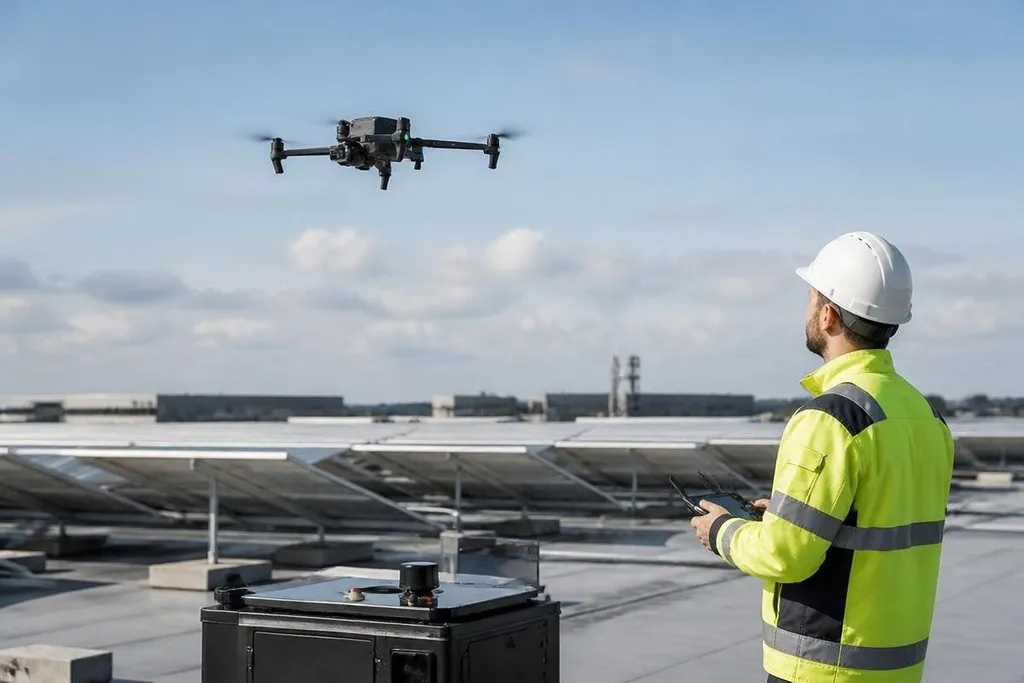
A drone that can plan a route, avoid obstacles, and return to its charging point can do more than carry a package. It can collect site data, inspect assets, and repeat the same flight without a pilot guiding every turn.
For a company weighing an autonomous drone service, the business case rests on repeatable work and useful data. The aircraft matters, but the service around it decides whether customers keep paying.
- Inspection: drones can check roofs, power lines, solar panels, and other assets from the air.
- Site data: cameras, thermal sensors, LiDAR, and GNSS can turn a flight into a work report.
- Remote operations: one control team can supervise flights while local staff handle exceptions.
Inspection is the clearest starting point
Inspection work has a fixed target, a known route, and a clear reason to return. That makes it easier to plan than open-ended delivery across a city.
The aircraft can carry a visible-light camera for images and a thermal camera for heat differences. LiDAR measures distance with laser pulses, while GNSS gives the aircraft a position reference. Each sensor answers a different question, so the service can sell a report instead of a flight.
A roof operator may need images of damaged panels. A power company may need signs of heat around equipment. A construction team may need a current site map. The customer pays for a decision made from that data, such as where to send a repair crew.
That changes the buyer. The customer may be a facilities manager, an insurer, a utility, or a construction firm rather than a person waiting for a parcel. These buyers also have a reason to schedule repeat work, which gives the operator a steadier service to build around.
The software work sits beside the aircraft
Autonomy doesn't remove the need for people. It moves their work toward route planning, airspace checks, fleet health, data review, and response when a flight meets something the software can't handle.
A business can sell several parts of that system. It might manage flights for a client, process images into inspection reports, or install a drone station at a remote site.
The station can charge the aircraft and protect it between missions, but the site still needs rules for access, weather, safety, and maintenance.
Those rules can decide whether an inspection service earns money before delivery becomes practical. Reporting on autonomous systems from Robot24.com gives founders facts about the aircraft and software behind each service as they compare business models.
Delivery still attracts attention, but it carries harder operating problems. The drone must handle changing landing areas, people, buildings, battery limits, and local flight rules. A company that starts with repeatable inspection work may reach a paying customer sooner than one that begins with doorstep delivery.
Data can become the lasting service
A single image has limited value. A series of flights can show change over time, which helps a customer plan repairs and compare sites.
That service needs careful data handling. The operator must record when and where images were taken, keep files tied to the right asset, and give the customer a report they can act on. A map with no clear finding creates more work, not less.
The open question is how much of the process can run without human review. A system may spot a heat pattern or a damaged surface, but a person still needs to check false alarms before a repair decision carries a large cost.
Where the business can fail
Autonomous flight depends on more than flight software. Weather, poor satellite signals, blocked routes, battery condition, and local rules can stop a mission or force a manual handoff.
Privacy can also limit the work. A drone flying near homes, roads, or public spaces may collect images that the customer never asked for. Clear flight boundaries, limited data storage, and a written response plan matter before the first paid job.
The economics need a plain test: does the service remove enough site visits, downtime, or inspection risk to cover the aircraft, sensors, software, staff, insurance, and maintenance? If the answer depends on perfect weather and zero exceptions, the plan needs more work.
A practical buying and planning check
Use this list before choosing an aircraft or promising a customer an autonomous service:
- Name the repeat task: write down the asset, route, inspection result, and visit schedule.
- Pick the sensor: use visible-light images for surface checks, thermal data for heat patterns, or LiDAR for distance and mapping.
- Set the human role: define who approves flights, watches alerts, and takes control when autonomy stops.
- Check the site: confirm launch areas, charging access, signal quality, weather limits, and nearby people.
- Price the report: charge for the finding and the work it saves, not only for minutes in the air.
- Plan the failure: decide what happens when the drone cannot finish, return, or send its data.
I'd back inspection and site-data services before consumer delivery because the work is easier to repeat and the buyer's need is clearer.
The next useful test is a small paid route with one asset type, one report format, and a written failure plan. If customers keep ordering the report, the drone has a business; if they only praise the flight, it has a demonstration.